Table of Contents
🎧 Hear the Difference (Kalimba Sound Demo):
If you are standing at the crossroads of your musical journey, trying to decide between a 17-key and a 21-key Kalimba, you are not alone. This is the single most common question we get from beginners.
Should you stick with the popular standard, or future-proof your purchase with more notes? The answer isn't just about "more keys is better"—it's about what songs you want to play and how portable you need your instrument to be.
The 17-Key Kalimba: The Classic Standard
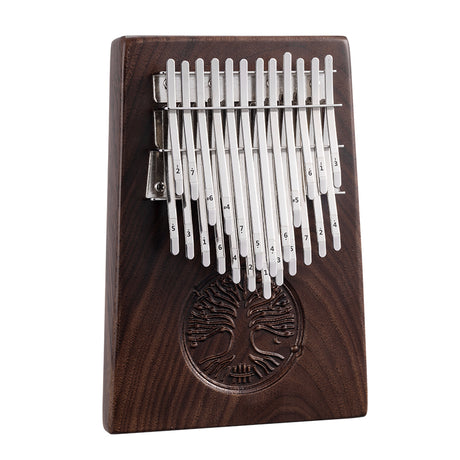
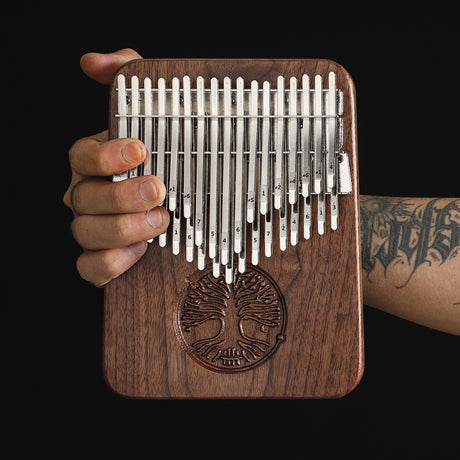
The 17-key Kalimba (tuned to C Major) is the industry standard. If you search for "Kalimba tabs" on YouTube or Google, 90% of the results are written specifically for this instrument.
Why Choose 17 Keys?
- Massive Song Library: You will find thousands of free tutorials and tabs instantly. You never have to worry about transposing music.
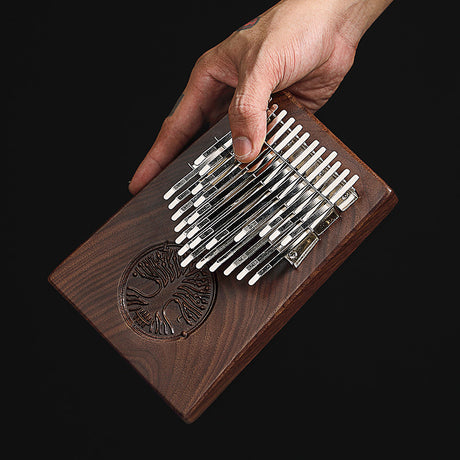
- Perfect Ergonomics: For most hand sizes, the 17-key body is the perfect width. It’s comfortable to hold for hours without stretching your thumbs.
- Budget-Friendly: It generally costs less than the 21-key version, making it a low-risk entry point for hobbyists.
The Limit: You are strictly bound to 2 octaves plus a few high notes. Some complex anime songs or classical pieces might require notes that simply aren't there.
The 21-Key Kalimba: The Modern Upgrade
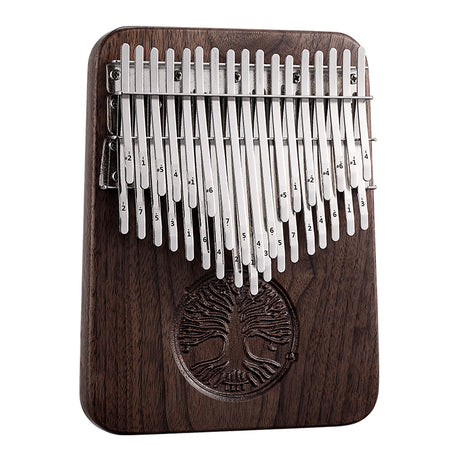
The 21-key Kalimba is essentially a 17-key instrument with 4 extra bass notes added to the center (Low 4, 5, 6, 7). Think of it as an expansion pack for your thumb piano.
Why Upgrade to 21 Keys?
- Richer Low End: Those extra keys are lower in pitch. This allows you to play deeper, more resonant bass accompaniment while playing the melody on the higher keys.
- No "Missing Note" Frustration: Have you ever found a song tab that required a low note your Kalimba didn't have? The 21-key solves that.
- Versatility: It can play everything a 17-key can play, plus more. You don't lose anything; you only gain range.
The Trade-off: The body is slightly wider to accommodate the extra tines. If you have very small hands (e.g., young children), the reach might feel a bit of a stretch initially.
What Do Those Extra 4 Keys Actually Do?
This is the technical part made simple. A standard 17-key Kalimba starts at Middle C (C4). A 21-key Kalimba usually starts at Low F (F3).
This extra range (F3, G3, A3, B3) is crucial for:
- Pop Ballads: Many love songs require those warm lower chords.
- Classical Music: Pieces often span more than 2 octaves.
- Solo Arrangements: The extra bass notes allow you to play "chords" and "melody" simultaneously without them clashing in the same frequency range.
Comparison Table: Quick Specs
| Feature | 17-Key Kalimba | 21-Key Kalimba |
|---|---|---|
| Total Range | 2 Octaves + 3 Notes | 3 Octaves (Full Bass) |
| Learning Resources | Abundant (90% of tabs) | Growing, but less common |
| Body Width | Standard (~13cm) | Wider (~14-15cm) |
| Best For | Beginners & Travel | Intermediates & Arrangers |
Verdict: Which One Matches Your Goal?
- Buy the 17-Key IF: You are a complete beginner, you are buying a gift for a child, or you prioritize portability. It is the best way to start without feeling overwhelmed.
- Buy the 21-Key IF: You already play piano or guitar, you plan to compose your own music, or you simply want the "best possible version" so you don't have to upgrade later.
Conclusion
Whether you choose the classic 17-key or the expansive 21-key, the Kalimba is a forgiving instrument. Unlike the violin or guitar, you will make beautiful sounds on day one with either model.
At Hluru, we ensure both versions are tuned to perfection before shipping. Listen to the demos in our shop and let your ears decide!
Frequently Asked Questions
Q: Is a 21-key Kalimba harder to learn?
A: Not really. The central 17 keys are arranged exactly the same way. You can play any 17-key song on a 21-key Kalimba by simply ignoring the 4 extra bass keys in the middle.
Q: Can I tune a 17-key to sound like a 21-key?
A: You can tune it down, but you will lose the high notes. The 21-key offers both low and high notes simultaneously, which is its main advantage.