
📖 Tabla de Contenidos
Principios clave de afinación
- Física de las lengüetas: Las lengüetas más largas producen notas de bajo más profundas; las lengüetas más cortas producen notas agudas.
- Golpear hacia abajo (alargar): Para bajar la afinación (arreglar una nota aguda).
- Golpear hacia arriba (acortar): Para subir la afinación (arreglar una nota grave).
El kalimba, también conocido como piano de pulgar, produce sonido por la vibración de las lengüetas metálicas. Estas lengüetas están fijadas en el cuerpo del kalimba, con diferentes longitudes que generan distintos tonos. Las lengüetas más largas, generalmente en el centro, crean notas de bajo más profundas, mientras que las lengüetas más cortas en los lados producen sonidos de tono más alto. Una afinación adecuada es esencial para lograr el mejor rendimiento musical.
Esta guía completa explica cada paso en detalle, incluyendo desafíos comunes y consejos profesionales para una afinación precisa.
1. Lo que necesitarás
Antes de comenzar, reúne estas herramientas esenciales para garantizar precisión y hacer que el proceso de afinación sea fluido y eficiente:
- Kalimba: El propio instrumento (17 o 21 teclas).
- Aplicación de afinación: Una aplicación en el teléfono inteligente que detecta frecuencias y notas de sonido (por ejemplo, Pano Tuner, Tunable).
- Martillo de afinación: Una pequeña herramienta metálica diseñada específicamente para golpear las lengüetas del kalimba.
- Tabla de afinación del kalimba: Una guía de referencia para las notas y frecuencias correctas.

2. Paso 1 y 2: Medición y comparación
Primero, abre la aplicación de afinación en tu teléfono y coloca tu kalimba cerca del micrófono del teléfono.
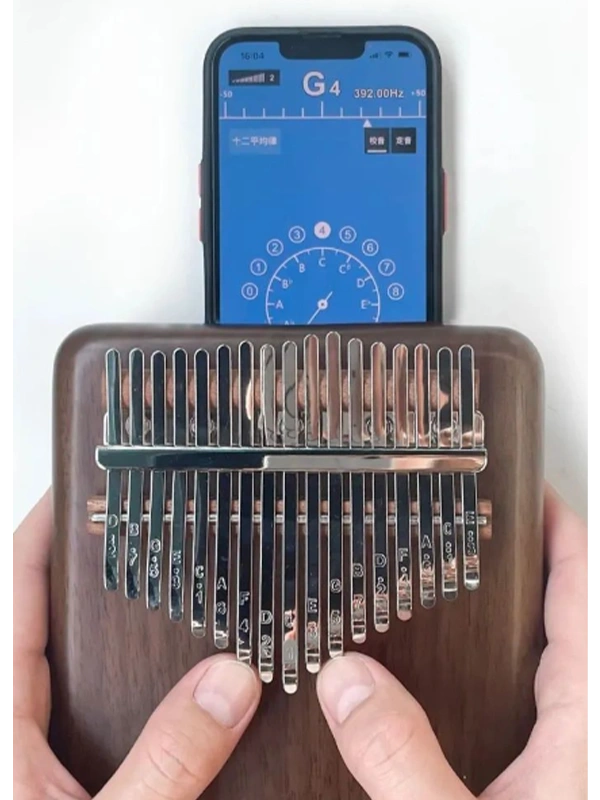
Comienza punteando las lengüetas con tu pulgar. Empieza desde el lengüeta central y trabaja de manera simétrica hacia los lados. Este orden es importante para la consistencia y organización.
Asegúrate de que la aplicación capture con precisión el sonido de cada lengüeta manteniendo el kalimba estable para minimizar el ruido de fondo.
Comparando con la tabla
Revisa la pantalla de la aplicación de afinación para identificar la nota que se está reproduciendo y compárala con tu tabla.
Consejo profesional: Si la aplicación muestra lecturas inestables (las notas fluctúan), consulta la valor de frecuencia en su lugar. Por ejemplo, una nota estándar A4 debe mostrar una frecuencia de 440 Hz.
3. Paso 3: Ajuste con el martillo
Este es el paso más crítico. Una vez que hayas identificado las discrepancias, usa tu martillo de afinación para mover físicamente las lengüetas.

Usa el martillo de afinación para golpear suavemente la parte superior de la lengüeta hacia abajo. Esto aumenta la longitud vibrante de la lengüeta, bajando la afinación.
Si la nota es demasiado BAJA (Grave b)Golpea el parte inferior de la lengüeta hacia arriba. Esto acorta la sección vibrante, elevando la afinación.
Verificación rápida para principiantes: Las notas del kalimba siguen la escala mayor de Do (C, D, E, F, G, A, B). Si la aplicación muestra una nota antes en esta secuencia de lo esperado, la tonalidad es aguda. Si aparece después, la tonalidad es grave.
[[PRODUCTOS_RELACIONADOS]]Paso 4: Solución de problemas comunes
Incluso con la técnica correcta, podrías enfrentar algunos desafíos acústicos. Aquí te mostramos cómo resolverlos:
- Vibraciones simpáticas: Las lengüetas cercanas pueden vibrar al tocar una nota, causando lecturas incorrectas. Para evitar esto, presiona suavemente las lengüetas adyacentes con los dedos para silenciarlas mientras afinas la nota objetivo.
- Sensibilidad de la aplicación: Algunas aplicaciones de afinación tienen dificultades en entornos ruidosos. Siempre afina en una habitación tranquila.
- Ajustes grandes: Si una lengüeta está significativamente desafinada, realiza ajustes graduales (golpecitos pequeños) para evitar correcciones excesivas.
Paso 5: Afinación fina y verificación
Después de ajustar cada lengüeta, repasa todo el conjunto nuevamente. Toca cada nota y compárala con la tabla de afinación. Confirma que todas las notas coincidan en nombre y frecuencia.
Consejos adicionales de mantenimiento:
1. Revisa regularmente: Con el tiempo, las lengüetas pueden desplazarse ligeramente debido al uso o las condiciones de almacenamiento.
2. No aprietes en exceso: Si tu kalimba tiene tornillos ajustables, asegúrate de que estén bien sujetos pero sin estar dañados.
Conclusión
Afinar una kalimba puede parecer desafiante al principio, pero con práctica y las herramientas adecuadas, se convierte en un proceso sencillo. Siguiendo estos pasos, puedes asegurarte de que tu kalimba produzca los sonidos hermosos y resonantes para los que fue diseñada. Haz de la afinación una parte regular de tu rutina con la kalimba y disfrutarás de un instrumento que siempre funciona en su mejor estado.