

A practical, musician-friendly guide explaining how hole geometry and placement affect a cajón’s voice, play feel and real-world use.
The sound hole on a cajón looks simple: usually a circular cut on the back panel. But that simple opening is one of the most powerful tone shapers in the instrument. Its diameter, shape, edge treatment and location determine how the internal air moves, how much sound pressure is radiated, and how the bass and slap balance in both recorded and live settings.
This article explains — in plain language — what changes when you alter hole size, how different hole shapes affect turbulence and tone, whether hole position matters for the player’s experience, and which type of cajón (ported vs sealed) suits different scenarios. It ends with practical buying recommendations and two real product suggestions so you can make a confident choice.
Fundamentals — what the hole actually does
The cajón is a box with a flexible front (tapa) and an internal air cavity. When you hit the tapa, the plate moves and compresses the air inside. The sound hole allows that air to move outward; the way it does so affects perceived bass response, transient attack and overall loudness.
Three simple ideas to remember:
- Hole size affects how easily air leaves the box—bigger hole = easier airflow and often more immediate SPL.
- Hole shape changes air turbulence and how harmonic content radiates (round vs slot vs multiple holes behave differently).
- Hole position affects how you hear the cajón (player vs audience) and can alter perceived bass and slap balance.
Hole size — small, medium, large (and what each one sounds like)
Most cajón holes range roughly from ~70 mm to ~120 mm in diameter. That 5 cm difference has audible effects.
Smaller holes (~70–85 mm)
Small apertures increase internal air impedance. Practically this results in a slightly stronger mid-bass “thump” and a sense of internal pressure: the bass feels rounded and warm rather than punchy. The sound decays a bit more slowly, which can be musically pleasing in solo or intimate acoustic settings.
Medium holes (~85–100 mm)
This is the “balanced” range. You get good low-end presence while keeping fast attack and workable projection. Most modern cajóns use holes in this area because it works well for recording and live performance.
Large holes (~100–120+ mm)
Larger holes couple the internal air to the outside world more efficiently — louder low-frequency SPL, quicker bass attack, and shorter decay. This is useful in band settings where punch and projection matter. The trade-off: the bass can feel less “round” and more direct, and snare/slap articulation can become relatively less distinct in the mix.
Hole shape — round, slot, multiple holes and how they change airflow
Shape matters. Two holes with identical area can behave differently depending on their geometry.
Round holes
Predictable and uniform radiation. Round cuts produce even coupling and are less likely to produce directional quirks. Rounded edges also reduce airflow noise at high strike forces.
Slots or slits
Elongated shapes change how air spreads along the back panel. Slots often produce a broader radiated pattern across mid-bass frequencies and can slightly smooth resonance peaks. Builders use slots to tune specific resonant behavior and to avoid a single “peaky” bass frequency.
Multiple smaller holes
Distributed holes can act like multiple small ports, widening the instrument’s low-frequency response and making the bass less focused on a single frequency. This can be desirable if you want a consistent tone across different rooms and mic positions.
Hole position — does it affect playability and tone?
Yes — but maybe not in the way you expect. Common positions: centered back, low-back (near the bottom edge), and side ports (on the side panel facing the player). Each placement changes who hears what and how the player feels the instrument.
Centered back holes
Balanced radiation pattern to the audience, consistent with typical speaker-like behavior. Good general-purpose design; easy to mic and predictable on stage.
Low-back holes
Placing the hole closer to the lower edge can strengthen the perceived bass when you play seated because the air movement flows in a slightly different mode. Some players say low-back holes give a “bigger” seated bass feeling. However, mic’ing is a little more finicky.
Side ports (player-facing)
Side ports help the player hear more low end while keeping audience projection moderate. This is useful in intimate settings where the player needs more tactile feedback but the band does not want excessive rear radiation.
Overall: hole position affects the player’s experience and mic strategy as much as it affects pure SPL. Try different positions in person if possible — you’ll notice subtle but real differences.
Sealed (no hole) / very small vents — why some cajóns omit the back hole
Some boutique cajóns intentionally reduce or remove the rear aperture. A sealed or near-sealed box increases internal pressure and often creates a warm, woody low-mid character. It can make the bass feel "fatter" to the player, though it often reduces measured low-frequency SPL outside the box.
Advantages of sealed designs:
- Very smooth, woody bass — pleasant for solo and studio work.
- Less direct rear radiation — useful for small-room dynamics.
- Unique voice that stands apart from standard ported cajóns.
Downsides:
- Lower external SPL at the lowest frequencies — can sound small in a band mix without support.
- Mic’ing can be more dependent on room mics and positioning.
- More sensitive to internal reflections and potentially narrow resonances — proper voicing by the builder is essential.
Microphone & EQ tips by hole type
How you mic a cajón depends on hole size and position. Here are simple rules you can apply on stage and in the studio.
Ported cajóns (regular rear hole)
- Place a dynamic mic near the hole (~10–20 cm) to capture bass body.
- Use a condenser near the top edge (15–25 cm off-axis) for slaps and high detail.
- EQ gently: low-shelf at ~80–120 Hz for warmth, presence boost around 2–4 kHz for slap clarity.
Sealed / small-hole cajóns
- Move the bass mic slightly farther back (20–30 cm) to let the mixed air integrate.
- Consider a room or ambient mic to capture natural low-end.
- EQ technique: narrow cuts to tame any ringing; gentle low-mid boost rather than large LF shelving.
DIY experiments you can try (safe and reversible)
Want to test different hole behaviors without permanent modification? Try these reversible tricks.
- Temporary plug: cut a cork or wooden disk slightly larger than your hole, drop it inside to reduce the effective area — listen for added warmth.
- Internal damping: place a thin foam pad or towel inside the back to simulate a smaller hole or sealed behavior.
- Edge smoothing: round the hole edge very slightly with fine sandpaper (from the inside) to reduce air crackle under very hard hits.
- Multiple-hole test: if you want to test multiple small ports, use removable adhesive patching to block or open small pilot holes instead of permanent drilling.
Buying guide — what to test in the shop
When you try cajóns, focus on these quick tests to decide if the hole design suits your needs:
- Play center bass & top slaps: listen for clarity and balance — does the slap cut through without destroying the bass?
- Sit and listen: does the bass feel different to you as a player compared with what the audience hears? (Side ports make the player feel more bassy.)
- Ask about hole diameter and location: if you want more projection, look for larger or multiple ports; for warmth, look for smaller or sealed designs.
- Test with a mic (if available): if you often play amplified, ask to mic the cajón and check how much EQ the engineer needs to make it sit.
- Check build quality: fine edge finishing, solid back panel attachment and consistent tapa thickness all help minimize unwanted artifacts.
Recommended models — ported vs sealed options
Cajón Drum White Tiger 49CN — (Ported / Tunable)
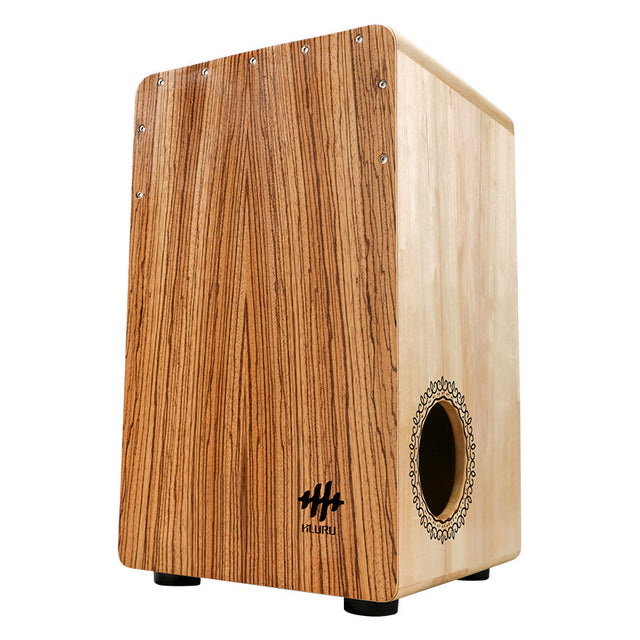
Price: 215 USD
Brand: HLURU (100% genuine)
Material: Domestic Poplar Wood (Zebra wood)
Suitable for: Beginners, Professionals, Schools
Snare: Military Drum String BAS01
Size: 485 × 298 × 292 mm
Thickness: Front 2.8mm | Side 12mm | Back 12mm
This model provides a tuned, ported voice with a responsive 2.8mm front plate and robust back thickness. The porting and snare choice make it a clear, modern-sounding cajón that projects well in band situations while remaining musically balanced for recording.
Ash Cajón Drum 48CN — Vermilion Bird (Sealed / Minimal Port)
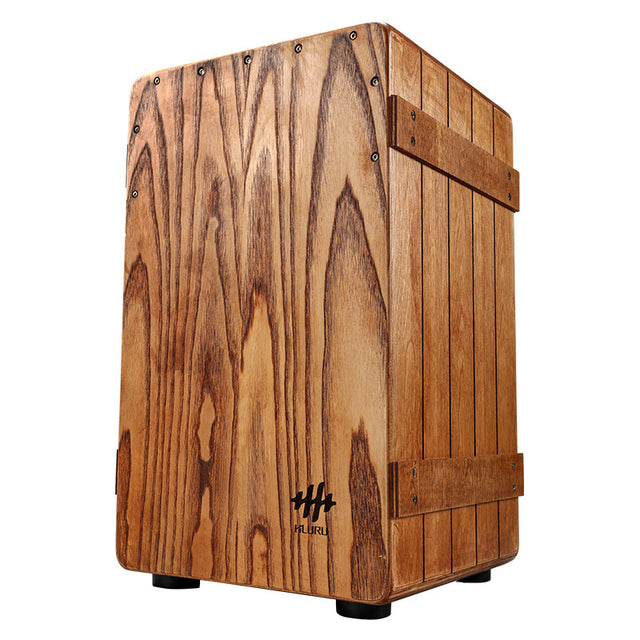
Price: 215.99 USD
Material: Drumhead: Chinese Ash | Drum box: Betula (multi-ply wood)
Suitable for: Beginners & Professional Players
Snare: TRE01 Snare (Guitar string)
Hitting feel: Harder (clear, defined slaps)
Size: 480 × 296 × 292 mm
Thickness: Front 2.8mm | Side 12mm | Back 7mm
The 48CN is tuned toward a warm, intimate palette with more controlled rear radiation. It works wonderfully for studio takes and quieter acoustic sets — especially where a woody, focused low-mid character is preferred.
FAQ — quick answers
Does a bigger hole always mean louder?
Not always — bigger holes generally increase low-frequency SPL outward, but the overall loudness depends on tapa stiffness, cavity volume and how the instrument is voiced. A poorly voiced large-hole cajón can still sound thin.
Will moving the hole change how I play?
The physical playing technique stays the same, but what you hear and feel can change. Side ports can make the cajón feel bassier to the player; centered ports give more audience projection. Play a few models to find the feel you like.
Can I modify my cajón’s hole?
Yes — but proceed cautiously. Temporary plugs and internal damping are reversible first steps. Permanent resizing or adding holes should be done by a skilled builder to avoid structural problems or unintended resonances.
Final thoughts
The sound hole is a simple-looking but deeply influential part of a cajón’s design. Size, shape and position affect airflow, SPL, transient feel and how the instrument sits in a mix. There’s no single correct design — the best choice depends on your playing context: solo or band, studio or stage, intimate or loud.
When choosing, take your time to play different hole designs, ask about hole diameter and position, and try the cajón both acoustically and with a mic if you perform amplified. Most importantly — choose the instrument that invites you to play more.