
📖 Table des matières
Principes clés de l’accordage
- Physique des tiges : Les tiges plus longues produisent des sons de basse plus profonds ; les tiges plus courtes génèrent des sons plus aiguës.
- Frapper vers le bas (allonger) : Pour baisser la hauteur (corriger une note aiguë).
- Frapper vers le haut (raccourcir) : Pour augmenter la hauteur (corriger une note grave).
Le kalimba, aussi appelé piano à pouces, produit du son par la vibration des tiges métalliques. Ces tiges sont fixées sur le corps du kalimba, avec des longueurs variables qui produisent différentes tonalités. Les tiges plus longues, généralement au centre, créent des sons de basse plus profonds, tandis que les tiges plus courtes sur les côtés produisent des sons plus aigus. Un accordage correct est essentiel pour obtenir la meilleure performance musicale.
Ce guide complet explique chaque étape en détail, y compris les défis courants et les astuces professionnelles pour un accordage précis.
1. Ce dont vous aurez besoin
Avant de commencer, rassemblez ces outils essentiels pour garantir la précision et rendre le processus d’accordage fluide et efficace :
- Kalimba : L’instrument lui-même (17 ou 21 clés).
- Application d’accordage : Une application pour smartphone qui détecte les fréquences et notes sonores (par ex., Pano Tuner, Tunable).
- Marteau d'accordage : Un petit outil métallique spécialement conçu pour taper sur les tiges du kalimba.
- Tableau d’accordage du kalimba : Un guide de référence pour les notes et fréquences correctes.

2. Étape 1 & 2 : Mesure et comparaison
Tout d’abord, ouvrez l’application d’accordage sur votre téléphone et placez votre kalimba près du microphone du téléphone.
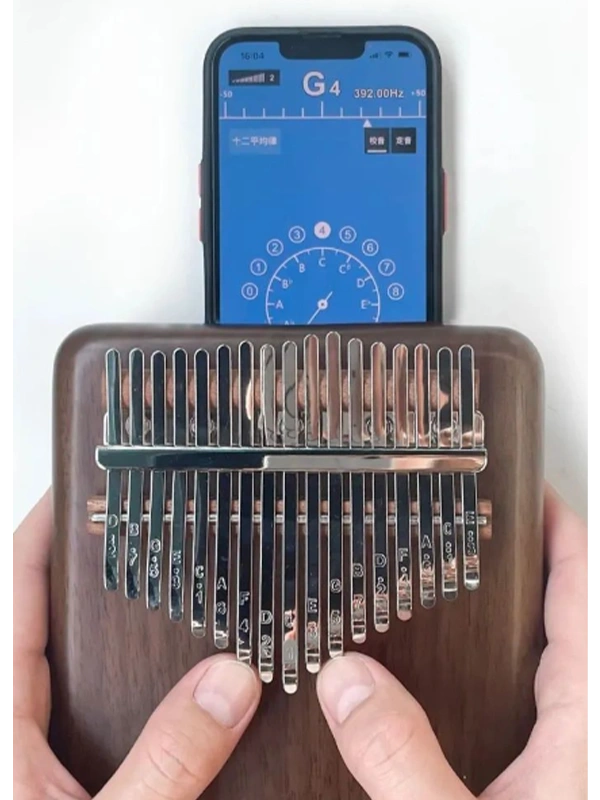
Commencez à pincer les tiges avec votre pouce. Commencez par le tige centrale et travaillez de manière symétrique vers les côtés. Cet ordre est important pour la cohérence et l’organisation.
Assurez-vous que l’application capte chaque son de tige avec précision en tenant le kalimba stable pour minimiser le bruit de fond.
Comparaison avec le tableau
Vérifiez l’affichage de l’application d’accordage pour identifier la note jouée et comparez-la à votre tableau.
Conseil pro : Si l’application affiche des lectures instables (les notes fluctuent), reportez-vous à la valeur de fréquence à la place. Par exemple, une note standard A4 doit afficher une fréquence de 440 Hz.
3. Étape 3 : Ajustement avec le marteau
C’est l’étape la plus critique. Une fois que vous avez identifié les écarts, utilisez votre marteau d’accordage pour déplacer physiquement les tiges.
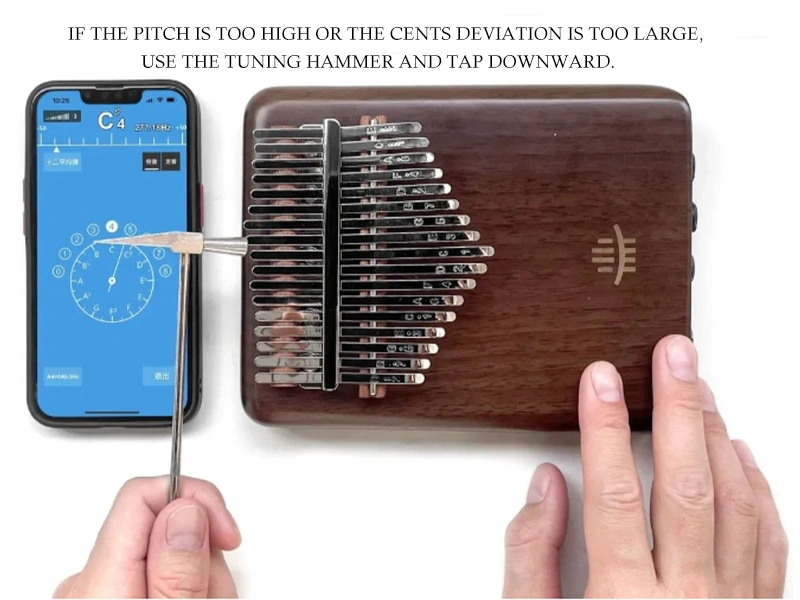
Utilisez le marteau d’accordage pour tapoter doucement la haut de la tige vers le bas. Cela augmente la longueur vibrante de la tige, abaissant la hauteur.
Si la note est trop BASSE (Platte b)Frappez la extrémité inférieure de la tige vers le haut. Cela raccourcit la section vibrante, augmentant la hauteur.
Vérification rapide pour les débutants : Les notes du kalimba suivent la gamme majeure de Do (C, D, E, F, G, A, B). Si l’application affiche une note plus tôt dans cette séquence que prévu, la tonalité est aiguë. Si elle est plus tardive, la tonalité est grave.
[[PRODUITS_ASSOCIÉS]]Étape 4 : Dépannage des problèmes courants
Même avec la bonne technique, vous pourriez rencontrer certains défis acoustiques. Voici comment les résoudre :
- Vibrations sympathiques: Les lamelles voisines peuvent vibrer lors de la pincée d’une note, ce qui entraîne des lectures incorrectes. Pour éviter cela, pressez doucement les lamelles adjacentes avec vos doigts pour les étouffer pendant l’accordage de la note cible.
- Sensibilité de l’application : Certaines applications d’accordage ont du mal dans des environnements bruyants. Toujours accorder dans une pièce calme.
- Ajustements importants : Si une lamelle est nettement désaccordée, effectuez des ajustements progressifs (pettes coups) pour éviter une correction excessive.
Étape 5 : Finition et vérification
Après avoir ajusté chaque lamelle, repassez en revue l’ensemble. Pinchez chaque note et comparez-la au tableau d’accordage. Confirmez que toutes les notes correspondent en nom et en fréquence.
Conseils d’entretien supplémentaires :
Négliger l’entretien Vérifiez régulièrement : Avec le temps, les lamelles peuvent légèrement se déplacer en raison de l’utilisation ou des conditions de stockage.
Une chaleur excessive constante + tension + pointes fragiles = cassures. Les extensions sont résistantes, mais vos cheveux naturels dessous ont aussi besoin de protection. Ne pas trop serrer : Si votre kalimba possède des vis réglables, assurez-vous qu’elles sont bien serrées mais sans être endommagées.
Conclusion
L’accordage d’un kalimba peut sembler difficile au début, mais avec de la pratique et les bons outils, cela devient un processus simple. En suivant ces étapes, vous pouvez garantir que votre kalimba produit les sons beaux et résonants qu’il est censé avoir. Faites de l’accordage une partie de votre routine régulière, et vous profiterez d’un instrument qui fonctionne toujours à son meilleur niveau.