🔍 Quality Checklist (Tap to Collapse)
What Makes a Drum "Good"?
- Precision Tuning: A high-quality drum must be tuned within ±5 cents. Anything more sounds "sour."
- No Crosstalk: Hitting one note should NOT cause adjacent notes to hum uncontrollably.
- Clean Decay: The sound should fade smoothly without a metallic "clunk" at the end.
You’ve seen them online. Two tongue drums look identical. One costs $30, and the other costs $150. Is it just branding? Absolutely not.
As a sound therapist and instrument maker, I often see clients frustrated because their cheap drum "just doesn't feel right." The problem isn't their playing—it's the physics of the instrument. Choosing a good tongue drum isn't about picking a color; it's about identifying three invisible flaws: poor intonation, crosstalk, and iron noise. This guide will teach you how to spot a professional instrument from a mass-produced toy.
1. The "Plus-Minus 5 Cents" Rule (Intonation)
The most fundamental requirement of any instrument is being in tune. In the world of steel drums, we measure accuracy in "cents" (1/100th of a semitone).
A good tongue drum is hand-tuned to an accuracy of ±5 cents. This requires a master tuner to carefully file away metal from the tongue. Cheap drums are often stamped by machines and painted thickly, leading to errors of ±20 cents or more. To the ear, a ±20 cent error makes chords sound muddy and unsettling rather than healing.
Test Your Ears
We recorded a "Toy Grade" drum vs. a "Master Grade" Hluru drum. Can you hear the wavering pitch in the cheap one?
2. Eliminating "Iron Noise" (Timbre Purity)
When you strike a tongue, you want to hear a musical note, not the sound of a spoon hitting a pot. That metallic "clank" is called Iron Noise.
A high-quality drum uses specialized alloys (often containing copper or titanium) and undergoes a heat treatment called annealing. This rearranges the crystal structure of the metal to minimize percussive noise and maximize the musical tone.
3. The Crosstalk Test (Interference)
This is the secret killer of cheap drums. Crosstalk happens when you hit one note (e.g., Low C), and the vibrations bleed into a nearby tongue (e.g., High G), causing it to hum when it shouldn't.
While some resonance is good, uncontrolled crosstalk creates a "blurry" sound that makes fast playing impossible. A good tongue drum has "cut lines" or internal dampening calculated to isolate notes, ensuring each tone is distinct and clear.
| Feature | 🚫 Toy Grade ($20-$50) | ✅ Instrument Grade ($100+) |
|---|---|---|
| Tuning Accuracy | ±15 to ±30 cents (Sour) | ±5 cents (Perfect Pitch) |
| Material | Recycled Thin Steel | Titanium Alloy / Nitrided Steel |
| Resonance | Short, Dead Sound (< 2 sec) | Long Sustain (> 4 sec) |
| Paint Job | Thick Spray (Muffles Sound) | Electroplating (Vibrates freely) |
4. Nitriding vs. Paint: The Finish Matters
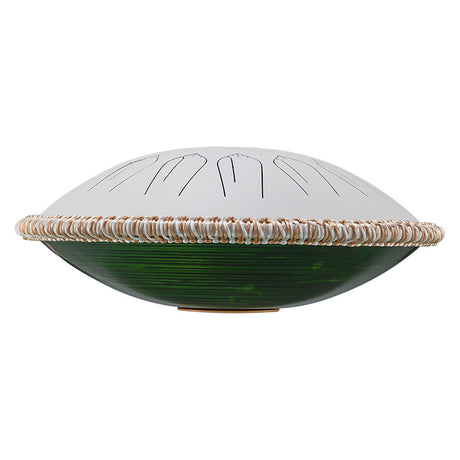
How a drum is finished affects its lifespan and sound. Avoid drums that look like they are covered in thick plastic-like paint. This is a cheap way to hide rust and poor metal quality.
Look for Nitrided Steel or Electroplated Finishes. Nitriding is a chemical process that hardens the steel surface, making it rust-proof and slightly ceramic. This produces a warmer, "wooden" tone that doesn't sound harsh to the ears.
5. The "Good Drum" Verdict
So, how do you choose? If you are buying a drum as a desk ornament, any cheap model will do. But if you are seeking stress relief, meditation, or musical expression, you must invest in quality.
- Check the Weight: A good 12-inch drum should weigh at least 2.5kg to 3kg. Heaviness indicates thicker, better metal.
- Listen for the "Wah-Wah": Strike the lowest note hard. It should sustain steadily. If the sound wobbles (wavers up and down), the tuning is unstable.
Conclusion
Choosing a good tongue drum is about respecting your own ears. A high-quality instrument invites you to play longer, dive deeper into meditation, and truly relax. A poor-quality one will sit in the closet after a week. Look for the signs of quality—pitch accuracy, pure sustain, and quality finishing—and your drum will serve you for a lifetime.