Table of Contents
Have you ever listened to a piece of music and felt a sudden wave of calmness wash over you? Not just because of the melody, but because of the vibration itself?
For decades, musicians, mathematicians, and mystics have argued that modern music (tuned to 440Hz) feels slightly "off"—like a shoe that is a size too tight. In contrast, 432Hz is described as the "frequency of the universe," a tuning that unlocks emotional healing and connects us deeper to nature.
But what does 432Hz actually mean? Is it just a myth, or is there a reason why this number appears in ancient history and sacred geometry?
The Definition: What Does 432Hz Actually Mean?
In simple musical terms, 432Hz refers to the tuning of the note "A" (A4) above Middle C. When we say an instrument is "tuned to 432Hz," we mean that the A note vibrates exactly 432 times per second.
While the modern standard is 440Hz (established in the mid-20th century), 432Hz is often called "Verdi's A" because the famous Italian composer Giuseppe Verdi advocated for a lower tuning to preserve the natural warmth of the human voice and instruments.
Think of it like lighting: 440Hz is like bright, white fluorescent office light (clear, sharp, alert). 432Hz is like warm, golden candlelight (soft, relaxing, natural).
The "God Note": Math, Nature, and Geometry
The obsession with 432Hz goes beyond music theory; it dives into the fabric of reality. Proponents believe this number is woven into the mathematics of the Earth itself.
1. The Golden Ratio (Phi)
Many sound healers believe that 432Hz aligns with the Golden Ratio (1.618), a mathematical pattern found everywhere in nature—from the spiral of a nautilus shell to the arrangement of sunflower seeds. Music tuned to this frequency is said to be mathematically consistent with the universe's design.
2. The Schumann Resonance
The "heartbeat" of the Earth (the electromagnetic resonance between the surface and ionosphere) resonates at a fundamental frequency of roughly 8Hz. On the musical scale of C, if you start at 8Hz and move up five octaves, you land precisely at 256Hz (Middle C), which results in an A tuned to 432Hz.
This is why people often say 432Hz grounds them—it is mathematically linked to the frequency of the planet we live on.
Why It Resonates: The Psychological Impact
Setting aside the math, how does it actually feel?
In the fast-paced digital era, our brains are constantly overstimulated. 432Hz music acts as a sonic balm. Because the pitch is slightly lower and the wavelengths are longer, the sound is perceived as:
- Softer on the ears: Less aggressive "attack" on the eardrums.
- Body-felt vibration: Many players of the Handpan or Kalimba report feeling the vibration more in their chest and heart center when playing in 432Hz.
- Emotional release: It is frequently used in trauma release therapy and deep meditation sessions because it bypasses the logical brain and speaks directly to the emotional body.
432Hz in Modern Instruments (Handpan & Tongue Drum)
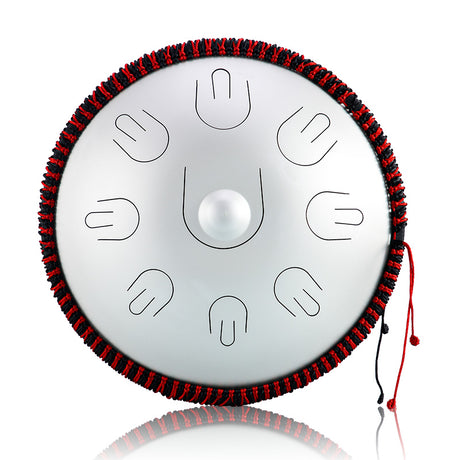
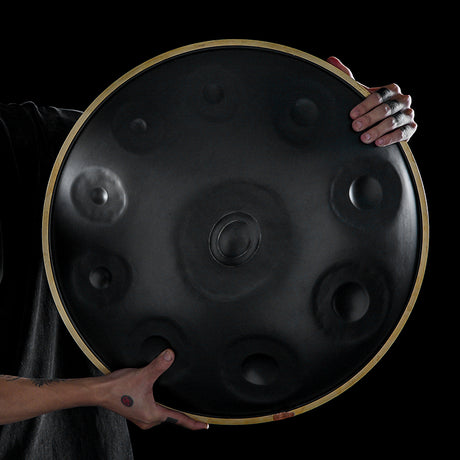
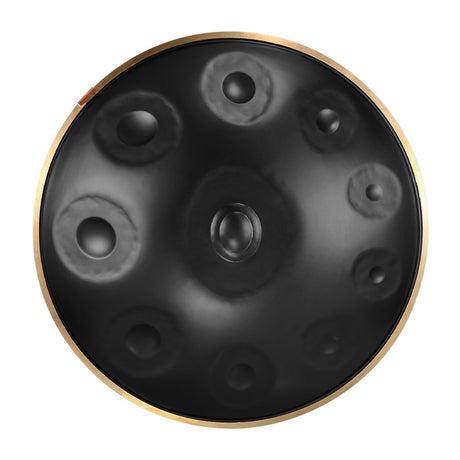
At Hluru, we see a massive demand for 432Hz instruments, particularly in our Handpan and Steel Tongue Drum collections.
Why these instruments specifically? Because they are naturally resonant. Unlike a guitar which plucks a string, a steel drum sustains a note for a long time. This long sustain allows the 432Hz frequency to bloom fully, creating a "sound bath" effect that wraps around the player.
If your goal is to perform in a loud band, stick to standard tuning. But if your goal is to close your eyes, breathe, and find a moment of peace after a long day at work, a 432Hz instrument is a powerful tool.
Conclusion: Listen with Your Heart
Science may debate the exact physical benefits, but the subjective experience of millions of people cannot be ignored. The "meaning" of 432Hz is not found in a textbook; it is found in how it makes you feel.
It represents a return to nature, a slowing down of time, and a tuning-in to a softer, gentler rhythm of life. In a loud world, 432Hz is a whisper that says: "Relax. You are safe."
FAQ: Common Curiosities
Q: Is 432Hz better for plants?
A: Interestingly, several amateur experiments suggest that plants grow faster and healthier when exposed to 432Hz classical music compared to harsh noise, though this is not definitive scientific law.
Q: Can I use a digital tuner to tune my instrument to 432Hz?
A: Yes! Most modern clip-on tuners allow you to change the "Reference Pitch" from 440Hz to 432Hz. However, you can only do this with tunable instruments (like guitars). Fixed instruments like Handpans must be bought in the correct frequency.